
State of Accounting API Connectivity 2027: Data on 31 systems
We examined the APIs of 31 accounting and ERP systems used across Europe and North America. The study covers what an integration has to handle before the first record is synced: how it authenticates, how long its credentials stay valid, whether access can be revoked, how changes are reported and how much of the ledger the API returns. Data as of November 2026.

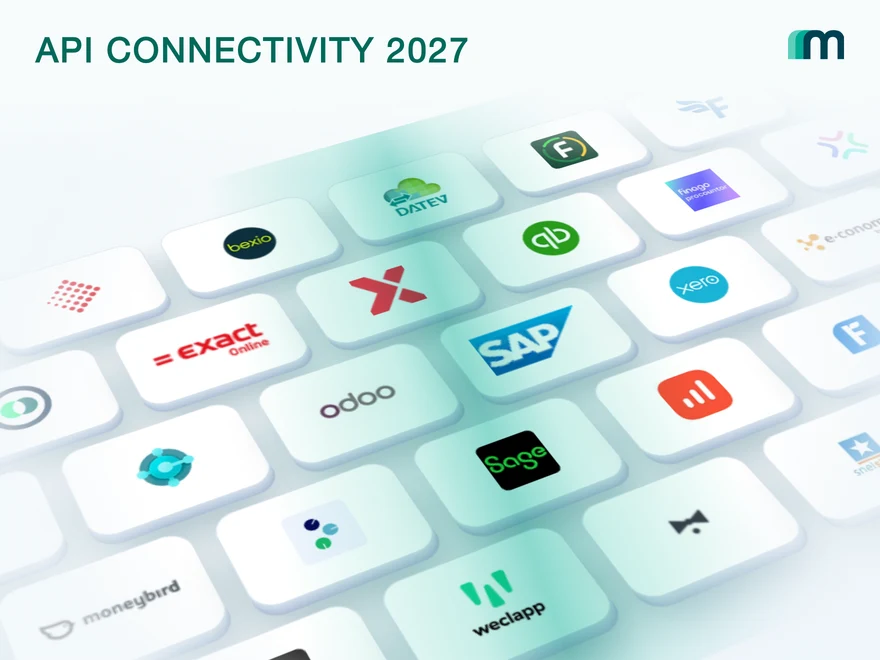
Five measures across 31 accounting systems
The figures come from the vendors' developer documentation and from our own production connections to these systems. They were collected in October and November 2026.
- 21 OAuth
- 1 consent flow with a static key
- 9 key or password copied by the customer
- 20 valid while in use, or no expiry
- 5 no expiry documented
- 5 documented limit
- 1 not published
- 17 yes
- 13 no documented call
- 1 unclear
- 13 native webhooks or events
- 5 limited
- 13 none
- 10 nested structure
- 21 no nested structure in the API
Each bar covers the same 31 systems, so the width of a segment is its share.
Methodology: 31 systems, two sources, October and November 2026
Systems. The study covers 31 accounting and ERP systems. The first fourteen in alphabetical order are Abacus, AbaConnect, bexio, BuchhaltungsButler, DATEV Rechnungswesen, DATEV Unternehmen Online, Dinero, Dynamics 365 Business Central, Exact Online, Fortnox, FreeAgent, FreshBooks, Holded and Lexware Office.
The other seventeen are Moneybird, Odoo, Pennylane, Procountor, Qonto, QuickBooks Online, Sage Accounting, Sage Active, sevdesk, SnelStart, Tripletex, Twinfield, Visma eAccounting (Spiris), Visma e-conomic, weclapp, Xentral and Xero.
All 31 are systems we connect to in production. The selection is not a random sample of the market and leans towards European systems.
Counting rule. A system counts once. Two vendors appear twice, because each of their two interfaces authenticates on its own and returns different data: DATEV with Rechnungswesen and Unternehmen Online, and Abacus with its REST API and the AbaConnect web services. Visma eAccounting and Spiris share one API and count once.
Three rules decide which route of a system the study describes:
- Where a sandbox authenticates differently from production, as with SnelStart, it describes production.
- Where a vendor offers further interfaces only under a partnership agreement, it describes the publicly documented one.
- Where a vendor documents separate routes for one company and for many customers, as Tripletex does, it describes the route for many customers.
Sources. The figures rest on two sources:
- Public developer documentation: API references, OpenAPI specifications, authentication guides, official changelogs and answers from vendor staff in developer forums.
- Our own production connections to each system. They are the only source for the finding on HTTP status 200 and the main source for SnelStart, whose documentation is behind a login. The cells on change notifications were checked on our connections as well.
Two cells rest on a third-party copy of vendor documentation: the account hierarchy and the per-account balance of SnelStart.
Collection period. Connection data reflects the state of 28 October 2026. Documentation was read between 12 and 16 November 2026. Every documented value was checked a second time against its source, most recently between 20 and 24 November 2026.
How to read the tables. Five labels recur in the tables:
- Unlimited: at least one credential of the system stays valid for as long as it is used, or does not expire.
- No and None: the vendor's documentation describes no such function. They do not mean that the vendor has ruled it out.
- No expiry documented: the documentation names no lifetime for a credential.
- Not published: a value exists and the vendor does not state it.
- Unclear: the second check could not confirm a value in either direction.
What we did not measure. Performance, rate limits, pricing and the range of objects each API covers are outside the scope of this study.
Definitions.
- OAuth: an authorisation flow in which the integration obtains access tokens from a token endpoint after the customer has approved the connection.
- Access token: the short-lived credential sent with each API call.
- Refresh token: the credential used to obtain a new access token. It is fixed if it expires at a set date that a refresh does not move, and sliding if every refresh renews it, so that it stays valid for as long as it is used.
- Static credential: an API key, personal token or username and password that does not go through an OAuth flow.
- Maximum credential lifetime: the longest any credential of a system stays valid before the customer has to authorise the connection again.
- Revocation: an API call with which the integrator can end a customer's connection.
- Change notification: a webhook or event the system sends when data changes. It is limited if the vendor documents it for few objects or if each customer has to set it up.
- Nested chart of accounts: the API returns a parent reference or child elements, on the accounts themselves or on the account groups or classification they belong to.
- Per-account balance: a balance per general ledger account that the API returns directly, as a field or as a trial balance, without adding up journal entries.
- Failed request with status 200: a request that did not deliver what was asked for and was answered with HTTP status 200.
Ten of 31 systems work without OAuth
Of 31 accounting systems examined, 21 offer OAuth, 1 issues a long-lived key through its own consent flow and 9 require the customer to copy an API key or password into the integration.
| Authentication | Systems | Count |
|---|---|---|
| OAuth | Abacus, bexio, Business Central, DATEV Rechnungswesen, DATEV Unternehmen Online, Dinero, Exact Online, Fortnox, FreeAgent, FreshBooks, Moneybird, Pennylane, Procountor, Qonto, QuickBooks Online, Sage Accounting, Sage Active, SnelStart, Twinfield, Visma eAccounting, Xero | 21 |
| Consent flow that issues a static key | Visma e-conomic | 1 |
| Key or password copied by the customer | AbaConnect, BuchhaltungsButler, Holded, Lexware Office, Odoo, sevdesk, Tripletex, weclapp, Xentral | 9 |
Two systems depart from the standard flow. SnelStart counts as OAuth here: the customer signs in and approves the connection, the integrator identifies itself with registered app credentials and a token endpoint issues access tokens valid for about an hour. The grant arrives by webhook as a connection key that does not expire.
Visma e-conomic also has the customer approve the connection in a browser. The key it issues is sent with every API call and is not exchanged for a short-lived token.
Six of the 21 OAuth systems also accept a static credential: bexio, Dinero, Moneybird, Pennylane, Procountor and Qonto. Among the systems without OAuth, two exchange the static credential for a session token: AbaConnect and Tripletex.
In almost two thirds of the systems, a connection stays valid while it is used
In 20 of 31 accounting systems, at least one type of credential stays valid for as long as the integration keeps using it, without the customer signing in again.
Access tokens
Among the 21 systems with OAuth, access tokens last between five minutes and 24 hours where the vendor publishes a lifetime, and in one system they do not expire.
The shortest access tokens are issued by Sage Accounting (5 minutes), Abacus and Exact Online (10 minutes each) and DATEV (15 minutes). One hour is the most common lifetime, in 9 of the 21 systems. Pennylane issues tokens valid for 24 hours.
Three values carry a reservation. FreshBooks shows 12 hours in its example and states that the lifetime may vary. Moneybird access tokens do not expire as of now, and the vendor reserves the right to change this. bexio publishes no lifetime.
AbaConnect has no OAuth and works with sessions. A session stays active until logout and expires after 15 to 20 minutes without activity.
Refresh tokens
What happens over months and years depends on the refresh token. Among the 21 systems with OAuth, refresh tokens follow these models:
| Refresh token model | Systems | Count |
|---|---|---|
| Sliding: every refresh renews the token (in brackets: how long it may go unused) | bexio (1 year), Business Central (90 days), DATEV Rechnungswesen and DATEV Unternehmen Online (2 years), Dinero (up to 365 days, one-time tokens), Exact Online (30 days), Fortnox (45 days), FreeAgent (about 20 years), Pennylane (90 days), Qonto (90 days), Sage Accounting (31 days), Visma eAccounting (2 years), Xero (60 days) | 13 |
| Fixed expiry | Sage Active (30 days), Abacus (at most 60 days), Procountor (6 months), Twinfield (25 years) | 4 |
| Sliding with a fixed cap | QuickBooks Online (100 days idle, 5 years maximum) | 1 |
| Does not expire | FreshBooks, SnelStart (connection key) | 2 |
| No lifetime published | Moneybird (its access token does not expire as of now) | 1 |
- Sliding: renewed on every refresh
- Fixed expiry
- Sliding with a fixed cap
- Exact Online30 days
- Sage Active30 days
- Sage Accounting31 days
- Fortnox45 days
- Abacusup to 60 days
- Xero60 days
- Business Central90 days
- Pennylane90 days
- Qonto90 days
- QuickBooks Online100 days, 5 years at most
- Procountor6 months
- bexio1 year
- Dineroup to 365 days
- DATEV Rechnungswesen2 years
- DATEV Unternehmen Online2 years
- Visma eAccounting2 years
- FreeAgentabout 20 years
- Twinfield25 years
Not shown: FreshBooks and SnelStart, whose refresh credential does not expire, and Moneybird, which publishes no lifetime. The axis is logarithmic.
Two of the 31 systems issue refresh tokens with a lifetime of 20 years or more.
Twinfield documents a lifetime of 25 years. FreeAgent's example response shows about 20 years, and each refresh returns a new refresh token with the same lifetime. FreeAgent staff note that the value in the documentation can change.
Dinero offers two kinds of refresh token. One-time tokens are sliding and may go unused for up to 365 days. Re-use tokens have a fixed lifetime of up to one year.
Static credentials
Sixteen systems issue a static credential. Three vendors state that it does not expire: Procountor, sevdesk and Visma e-conomic. Seven name no lifetime in their documentation: AbaConnect, BuchhaltungsButler, Dinero, Holded, Moneybird, Qonto and weclapp. Abacus names none for the client secret of its user-independent OAuth flow either.
Three vendors set a limit: bexio personal access tokens last 60 days, Odoo API keys at most three months and Lexware Office API keys at most 24 months. Pennylane lets the customer choose a lifetime up to unlimited, and Tripletex publishes none.
Xentral allowed tokens without expiry at the time of collection. From release 26.49, due on 8 December 2026, new tokens last at most 180 days, and existing tokens stay unchanged.
The longest-lived credential of each system
Taking every credential type of a system together, 20 of 31 systems allow a connection that the customer does not have to renew as long as it is in use. A further 5 name no expiry in their documentation. In 5 systems the longest-lived credential has a documented limit, and for 1 the limit is not published:
| Maximum credential lifetime | Systems | Count |
|---|---|---|
| Stays valid while in use, or does not expire | bexio, Business Central, DATEV Rechnungswesen, DATEV Unternehmen Online, Dinero, Exact Online, Fortnox, FreeAgent, FreshBooks, Moneybird, Pennylane, Procountor, Qonto, Sage Accounting, sevdesk, SnelStart, Visma eAccounting, Visma e-conomic, Xentral, Xero | 20 |
| No expiry documented | Abacus, AbaConnect, BuchhaltungsButler, Holded, weclapp | 5 |
| 30 days | Sage Active | 1 |
| 3 months (API keys) | Odoo | 1 |
| 24 months | Lexware Office | 1 |
| 5 years | QuickBooks Online | 1 |
| 25 years | Twinfield | 1 |
| Not published | Tripletex | 1 |
Four in ten systems document no API call to end a connection
In 13 of 31 accounting systems, an integrator has no documented API call to revoke a customer's connection.
In these systems the integrator can delete the credential it holds and cannot invalidate it at the system. The credential stays valid until it expires or until the customer removes it in the user interface.
| Revocation via API | Systems | Count |
|---|---|---|
| Yes | Abacus, bexio, DATEV Rechnungswesen, DATEV Unternehmen Online, Dinero, Fortnox, FreshBooks, Moneybird, Odoo, Pennylane, Procountor, Qonto, QuickBooks Online, Sage Accounting, Sage Active, Visma eAccounting, Xero | 17 |
| No | AbaConnect, BuchhaltungsButler, Business Central, Exact Online, FreeAgent, Holded, Lexware Office, sevdesk, SnelStart, Tripletex, Visma e-conomic, weclapp, Xentral | 13 |
| Unclear | Twinfield | 1 |
AbaConnect and Tripletex can end a session through the API, while the underlying credential stays valid, so the integration can sign in again at once. They count as No.
For bexio, the revocation endpoint is listed in the published OpenID configuration and is not described in the developer documentation. Twinfield's documentation lists no revocation endpoint, and the second check could not confirm whether one exists.
Thirteen systems send no change notifications
In 13 of 31 accounting systems, the vendor sends no change notifications, so an integration has to poll for changes.
| Change notifications | Systems | Count |
|---|---|---|
| Native webhooks or events | Business Central, Exact Online, Fortnox, FreshBooks, Holded, Lexware Office, Moneybird, Qonto, QuickBooks Online, Tripletex, Visma e-conomic, weclapp, Xero | 13 |
| Limited: few objects, or only after setup by the customer | Dinero, Odoo, Pennylane, Procountor, Xentral | 5 |
| None | Abacus, AbaConnect, bexio, BuchhaltungsButler, DATEV Rechnungswesen, DATEV Unternehmen Online, FreeAgent, Sage Accounting, Sage Active, sevdesk, SnelStart, Twinfield, Visma eAccounting | 13 |
Fortnox delivers its events over WebSockets. Pennylane documents three events and marks the feature as beta. Dinero documents one webhook. Odoo sends webhooks through automation rules that each customer sets up in their own database.
Where no notifications exist, an integration has to ask the API at intervals whether anything has changed. How well that works depends on whether the API can filter by modification date, which this study did not examine.
Five systems answer failed requests with HTTP status 200
In 5 of 31 accounting systems, we observed failed requests that were answered with HTTP status 200.
This figure comes from our own connections. It counts only behaviour we observed, so the real number can be higher. An integration that checks only the status code treats these requests as successful.
We observed four patterns:
- The error is returned inside the response body. In two of the five systems, this is how the protocol reports errors, as with JSON-RPC and GraphQL.
- During maintenance, the API redirects to an HTML page that itself returns status 200.
- A parameter that does not match is ignored, and the API returns data for a different scope than requested.
- A request for a page beyond the last one returns another page of data.
In the last two cases, the response contains valid data, so the error does not surface until the numbers in the integrating product are wrong.
This finding is reported without system names, because it rests on observation and a vendor can change the behaviour at any time.
A third of the systems return a nested chart of accounts
In 10 of 31 accounting systems, the API returns the chart of accounts as a nested structure.
Without this structure, an integration that needs subtotals, for example for a balance sheet or a budget comparison, has to rebuild the grouping from account numbers or from the customer's configuration.
| Chart of accounts | Systems | Count |
|---|---|---|
| Nested structure | Abacus, bexio, BuchhaltungsButler, Exact Online, FreshBooks, Moneybird, Odoo, QuickBooks Online, Twinfield, weclapp | 10 |
| No nested structure in the API | AbaConnect, Business Central, DATEV Rechnungswesen, DATEV Unternehmen Online, Dinero, Fortnox, FreeAgent, Holded, Lexware Office, Pennylane, Procountor, Qonto, Sage Accounting, Sage Active, sevdesk, SnelStart, Tripletex, Visma eAccounting, Visma e-conomic, Xentral, Xero | 21 |
In five of the ten systems, the nesting sits on the accounts themselves: BuchhaltungsButler, FreshBooks, Moneybird, QuickBooks Online and weclapp. In the other five, it sits on account groups or on a classification that is linked to the accounts: Abacus, bexio, Exact Online, Odoo and Twinfield.
A system without a nested structure can still return an account type or a group for each account, as Visma e-conomic and Xero do.
Most systems return a balance per account
In 7 of 31 accounting systems, the API returns no balance per general ledger account.
In these systems, an integration has to read every journal entry and add the amounts up to arrive at an account balance, where the API returns journal entries.
| Per-account balance | Systems | Count |
|---|---|---|
| Available, as a field or a trial balance | Abacus, BuchhaltungsButler, Business Central, DATEV Rechnungswesen, Dinero, Exact Online, Fortnox, FreeAgent, FreshBooks, Holded, Moneybird, Odoo, Pennylane, Procountor, QuickBooks Online, Sage Accounting, Sage Active, SnelStart, Tripletex, Twinfield, Visma eAccounting, Visma e-conomic, Xero | 23 |
| Not available | AbaConnect, bexio, DATEV Unternehmen Online, Lexware Office, Qonto, sevdesk, weclapp | 7 |
| Unclear | Xentral | 1 |
The balance a system reports differs in kind. Some systems return the current balance on the account, others a trial balance for a period, and some do both.
Two entries in the second row need a note. Qonto is a business account: its API returns balances per bank account and has no general ledger accounts. AbaConnect has a balance interface that exports XML and ASCII files and is not offered as a web service.
Xentral is listed as unclear. Its general ledger endpoint is in beta, and its documentation does not describe a balance field in the response.
All 31 systems at a glance
Authentication and static credentials
| System | Authentication | Static credential | Max. lifetime |
|---|---|---|---|
| Abacus | OAuth | None | No expiry documented |
| AbaConnect | Username and password | No expiry documented | No expiry documented |
| bexio | OAuth, personal token | 60 days | Unlimited |
| BuchhaltungsButler | API key | No expiry documented | No expiry documented |
| Business Central | OAuth | None | Unlimited |
| DATEV Rechnungswesen | OAuth | None | Unlimited |
| DATEV Unternehmen Online | OAuth | None | Unlimited |
| Dinero | OAuth, API key | No expiry documented | Unlimited |
| Exact Online | OAuth | None | Unlimited |
| Fortnox | OAuth | None | Unlimited |
| FreeAgent | OAuth | None | Unlimited |
| FreshBooks | OAuth | None | Unlimited |
| Holded | API key | No expiry documented | No expiry documented |
| Lexware Office | API key | At most 24 months | 24 months |
| Moneybird | OAuth, personal token | No expiry documented | Unlimited |
| Odoo | API key | At most 3 months | 3 months (API keys) |
| Pennylane | OAuth, company token | Up to unlimited | Unlimited |
| Procountor | OAuth, API key | No expiry | Unlimited |
| Qonto | OAuth, API key | No expiry documented | Unlimited |
| QuickBooks Online | OAuth | None | 5 years |
| Sage Accounting | OAuth | None | Unlimited |
| Sage Active | OAuth | None | 30 days |
| sevdesk | API token | No expiry | Unlimited |
| SnelStart | OAuth with connection key | None | Unlimited |
| Tripletex | Employee token | Not published | Not published |
| Twinfield | OAuth | None | 25 years |
| Visma eAccounting (Spiris) | OAuth | None | Unlimited |
| Visma e-conomic | Grant token via consent flow | No expiry | Unlimited |
| weclapp | API token | No expiry documented | No expiry documented |
| Xentral | Personal access token | No limit at collection, 180 days for new tokens from 8 December 2026 | Unlimited |
| Xero | OAuth | None | Unlimited |
Access and refresh tokens
| System | Access token | Refresh token |
|---|---|---|
| Abacus | 10 min | Fixed, at most 60 days |
| AbaConnect | Session, ends after 15 to 20 min idle | None |
| bexio | Not published | Sliding, 1 year idle |
| BuchhaltungsButler | None | None |
| Business Central | 60 to 90 min | Sliding, 90 days idle |
| DATEV Rechnungswesen | 15 min | Sliding, 2 years idle |
| DATEV Unternehmen Online | 15 min | Sliding, 2 years idle |
| Dinero | 1 h | Sliding, up to 365 days idle (one-time tokens) |
| Exact Online | 10 min | Sliding, 30 days idle |
| Fortnox | 1 h | Sliding, 45 days idle |
| FreeAgent | 1 h | Sliding, about 20 years idle |
| FreshBooks | 12 h in the vendor's example | Does not expire |
| Holded | None | None |
| Lexware Office | None | None |
| Moneybird | Does not expire as of now | Not published |
| Odoo | None | None |
| Pennylane | 24 h | Sliding, 90 days idle |
| Procountor | 1 h | Fixed, 6 months |
| Qonto | 1 h | Sliding, 90 days idle |
| QuickBooks Online | 1 h | Sliding, 100 days idle, 5 years cap |
| Sage Accounting | 5 min | Sliding, 31 days idle |
| Sage Active | 8 h | Fixed, 30 days |
| sevdesk | None | None |
| SnelStart | About 1 h | Connection key, does not expire |
| Tripletex | Session, expiry set by the caller | None |
| Twinfield | 1 h | Fixed, 25 years |
| Visma eAccounting (Spiris) | 1 h | Sliding, 2 years idle |
| Visma e-conomic | None | None |
| weclapp | None | None |
| Xentral | None | None |
| Xero | 30 min | Sliding, 60 days idle |
Revocation, notifications and ledger data
| System | Revocation | Notifications | Hierarchy | Balance |
|---|---|---|---|---|
| Abacus | Yes | None | Nested | Yes |
| AbaConnect | No | None | Not nested | No |
| bexio | Yes | None | Nested | No |
| BuchhaltungsButler | No | None | Nested | Yes |
| Business Central | No | Native | Not nested | Yes |
| DATEV Rechnungswesen | Yes | None | Not nested | Yes |
| DATEV Unternehmen Online | Yes | None | Not nested | No |
| Dinero | Yes | Limited | Not nested | Yes |
| Exact Online | No | Native | Nested | Yes |
| Fortnox | Yes | Native | Not nested | Yes |
| FreeAgent | No | None | Not nested | Yes |
| FreshBooks | Yes | Native | Nested | Yes |
| Holded | No | Native | Not nested | Yes |
| Lexware Office | No | Native | Not nested | No |
| Moneybird | Yes | Native | Nested | Yes |
| Odoo | Yes | Limited | Nested | Yes |
| Pennylane | Yes | Limited | Not nested | Yes |
| Procountor | Yes | Limited | Not nested | Yes |
| Qonto | Yes | Native | Not nested | No |
| QuickBooks Online | Yes | Native | Nested | Yes |
| Sage Accounting | Yes | None | Not nested | Yes |
| Sage Active | Yes | None | Not nested | Yes |
| sevdesk | No | None | Not nested | No |
| SnelStart | No | None | Not nested | Yes |
| Tripletex | No | Native | Not nested | Yes |
| Twinfield | Unclear | None | Nested | Yes |
| Visma eAccounting (Spiris) | Yes | None | Not nested | Yes |
| Visma e-conomic | No | Native | Not nested | Yes |
| weclapp | No | Native | Nested | No |
| Xentral | No | Limited | Not nested | Unclear |
| Xero | Yes | Native | Not nested | Yes |
Sources by system
Sourcing note
This study was compiled by maesn, which builds and operates integrations to the 31 systems covered. The figures reflect public documentation and our connections as of November 2026. APIs change, and individual values may be out of date by the time you read this. Corrections from vendors are welcome through our contact page and will be marked in the text.
How we work with these differences ourselves is described on the pages for unified authentication, unified webhooks and unified error handling.
To cite: maesn, State of Accounting API Connectivity 2027, data as of November 2026, https://www.maesn.com/blog/state-of-accounting-api-connectivity-2027/
Frequently asked questions
Can I quote figures from this study?
Are the figures representative of the whole accounting software market?
What is the difference between OAuth and a static credential for an integration?
What can an integrator do when a system has no revocation call?
Why is a failed request with HTTP status 200 a risk for financial data?
What does a nested chart of accounts allow an integration to do?
Lexware Office Partnership Guide: Public API or Partner Route
The Lexware Office Public API runs on an API key from the XL plan. Reaching every plan takes a technology partnership. How Lexware's qualification works.
 Dr. Themo Voswinckel · 24 Nov 2026
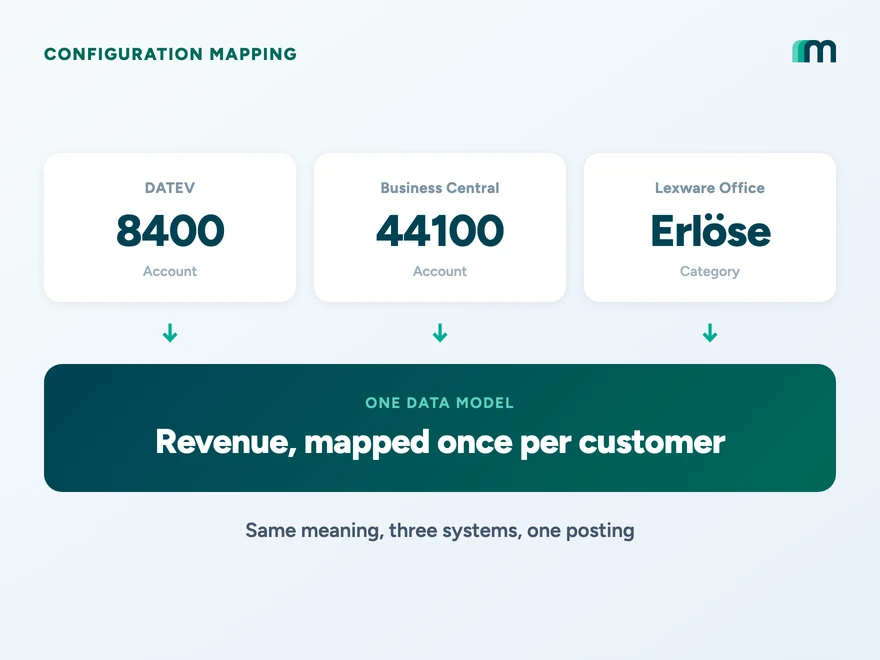
Chart of Accounts Mapping: Cover Every ERP Customisation
Map each object in your platform to the right account, tax code, dimension and company code in your customer's ERP. Standard and custom configuration in one step.
Dr. Themo Voswinckel · 2 Nov 2026
How to Integrate with Tripletex: One Session Token to Send
Tripletex combines two tokens into a third, puts the company in the username field and numbers new journal lines by row. What that means when you build.
Lennart Svensson · 24 Sept 2026Build once on the Unified API.
See the systems of this study in the integration directory, or read the technical reference.