
Lexware Office Partnership Guide: Open your integration to every Lexware Office plan
You can integrate with Lexware Office without a partnership. The Public API authenticates with an API key that your customer creates, and it works for every customer on the Lexware Office XL plan. A partnership becomes necessary once the integration should be open to Lexware Office customers on every plan.

What the Lexware Office customer base means for your product
Lexware puts the customer base of Lexware Office at well over 450.000 and says that one in five already benefits from a connection to other software. More than 8.000 customers join every month, and 30% of each year’s new customers add a partner solution.
Lexware Office is built for the self-employed and for small businesses, who prepare their bookkeeping there before it goes to the tax advisor. If you sell software to German small businesses, part of your own customer list works in this system every day.
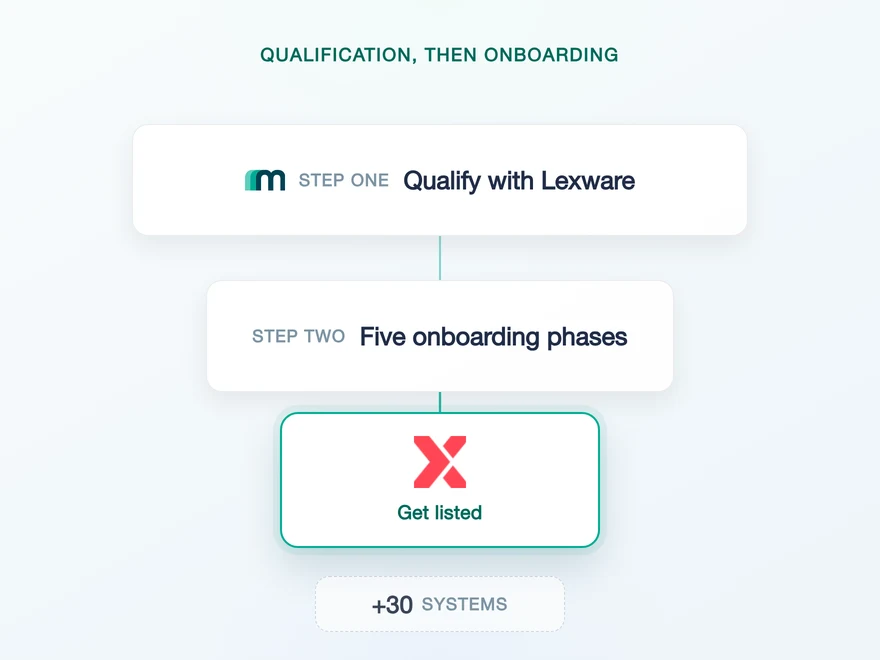
Two routes lead into that customer base, the Public API and a technology partnership. Lexware decides on the partnership in a manual qualification with its partner team, and our Lexware Office integration supports both routes.
Customer figures from Lexware’s partner models page and its partner programme, checked 20 November 2026.
The Public API works without a partnership, on an API key from the XL plan
The Public API is a REST API that any developer can build against, with no approval step on Lexware’s side. Access depends on the subscription of your customer: Lexware’s Help Center states that the Public API requires Lexware Office XL.
Your customer opens the Public API page under the extensions of their own account and creates a key, either with all permissions or with a selected set. Lexware displays the key once. Permissions are fixed at creation, so a change of scope means a new key.
Validity is capped at 24 months. Before the expiry date the customer can extend the key by another 24 months or copy it into a new key with the same permissions. A key that runs out is deactivated and deleted, and the connection stops with it.
Webhook subscriptions belong to the key as well: the Lexware API documentation states that they are removed once a key is invalidated. The same documentation sets the rate limit at two requests per second.
Plan requirement, key creation, permissions and validity from Lexware’s Help Center article on the Public API, dated 25 August 2026. Webhook subscriptions and the rate limit from the Lexware API documentation, checked 20 November 2026.
A key belongs to one Lexware Office account, so a platform collects one key per customer. On our API the customer pastes it into maesn Connect, or you submit it through the create account endpoint. From then on every request carries your API key and one account key, the same two headers as for any other connected system. That is what unified authentication covers.
This route is enough when your customers are predominantly on XL or when you build a project for a single company. For the second case Lexware has a model of its own: integration partners (Integrationspartner) deliver individual software projects for their customers on the Public API.
A technology partnership opens the integration to customers on every plan
Technology partners (Technologiepartner) connect their software to Lexware Office independently of the plan a customer is on. Lexware describes a technology partner as a vendor that runs its own full software product, and names banking solutions, online shops, CRM and time tracking as examples.
- Your customer is on Lexware Office XL
- They create an API key in their own account
- The key is valid for at most 24 months, renewable
- Your customer is on any plan
- They authorise in a Lexware screen through OAuth
- No API key involved
Both routes run on one implementation. We support both routes on our API. A platform that starts on API keys and qualifies later moves every connected customer to the new authorisation.
Next to the reach into its customer base, Lexware names four advantages for technology partners:
- You present yourself as a Lexware Office partner on your own website and in Lexware’s partner listing.
- Onboarding packages support the implementation.
- Lexware keeps extending the functional scope of its API and informs partners about new functions exclusively and promptly.
- Lexware supports partner marketing, online and offline.
Definition, examples and the four advantages from Lexware’s partner models page, checked 20 November 2026.
For your customer the way to connect changes. They authorise it in a Lexware screen through OAuth and never create or copy a key, and the XL requirement falls away.
For your product, the partnership opens a wider set of endpoints and operations than the Public API and a higher rate limit. We support both routes on our API, including the additional endpoints. For the build itself, see how to integrate with Lexware Office and pagination in Lexware Office.
The listing has two places. One is the partner listing on lexware.de, with a landing page of your own. The other is inside Lexware Office under the extensions (Erweiterungen), Lexware’s marketplace in the product, where Lexware currently counts more than 160.
Your company becomes the technology partner, and the integration runs on maesn
You qualify under your own name, and the listing carries your brand. maesn is the technology provider behind the connection: the integration your customers use runs on our API.
Public API and technology partnership side by side
The two routes differ most in which of your customers can connect.
| Criterion | Public API | Technology partnership |
|---|---|---|
| Built for | One company, or a platform whose customers are on XL | Software vendors with customers on every Lexware Office plan |
| Approval by Lexware | None | Manual qualification with the partner team, prepared and accompanied by maesn |
| Customer’s plan | Lexware Office XL | Any plan |
| How the customer connects | Creates an API key in their own account | Authorises in a Lexware screen through OAuth |
| Key lifetime | At most 24 months, renewable | No API key involved |
| Access | Publicly documented endpoints | Wider set of endpoints and operations |
| Rate limit | Two requests per second | Higher |
| Visibility | None without a partner model | Partner listing on lexware.de and extensions in the product |
| Time to first customer | Once your integration is built | 12 to 16 weeks by Lexware’s phase estimates, shorter through maesn |
| Programme fees | None | None |
Choose the route before launch. A platform that starts on API keys and qualifies later moves every connected customer to the new authorisation, so each of them connects a second time. On our API the switch is a small configuration change, and the data model and your requests stay as they are.
Lexware decides on technical fit and on how your product complements its own
Lexware accepts technology partners in a manual process, and its partner team reviews every request individually.
Publicly, Lexware says that in principle any company with its own software can apply and that the fit is clarified in an initial call (Erstgespräch). The application form asks how many active customers your app has, in bands from 50 to more than 1.000.
From the qualifications we have accompanied, four points come up every time:
- The use case, described precisely. Which records your product reads and writes in Lexware Office and at which step of your customer’s workflow.
- A domain of your own. Lexware Office covers invoicing, receipt capture and the preparatory bookkeeping. The partner team looks for products that add their own domain and offer complementary functions to Lexware.
- Relevance for Lexware’s customers. How many of your customers already work with Lexware Office, and what they do with your product today.
- Technical fit. The way your integration works has to fit the functions of Lexware Office, so that one workflow runs across both applications.
Banking and payment products should expect one more topic. It applies when your product transmits vouchers in addition to the bank transactions and the two should be matched directly in Lexware Office.
Lexware provides an identifier of its own for this, the end-to-end ID. It is sent with the bank transaction through PSD2 (independently of maesn) and with the voucher through the API. The end-to-end ID is part of our common data model as an identifier.
The bar is high for a reason. A partnership includes the listing and joint marketing, so Lexware places its name next to yours.
Who can apply and the initial call from Lexware’s partner models page, the customer bands from its application form for technology partners, both checked 20 November 2026. The four points are our own experience from qualifications we have accompanied.
maesn prepares the request and takes it to Lexware first
We run the qualification together with the platforms that integrate through us, and we have accompanied software vendors, fintechs, neobanks and banks through it. HERO Software integrates with Lexware Office through maesn. Holvi was already a Lexware partner as a bank and now runs a wide range of further business processes through our API.
The qualification runs in this order:
- You send us the request. Your product, your typical customers and the use cases you want to cover with Lexware Office.
- We structure the case. Use case, data flows and the argument for why your product complements Lexware Office.
- We approach Lexware on our own. We present the request to the partner management and discuss it with them.
- A joint deep dive. After a positive signal, Lexware, your team and we meet. This session decides whether the partnership starts.
- The onboarding starts. After a positive decision, Lexware’s onboarding begins, and you supply the material for the landing page and the listing.
What maesn takes over in the qualification
We guide you through the qualification from the first request to the launch. The technical side comes down to a quick check by Lexware, because your connection to our API includes the tested integration to Lexware Office.
We are a Lexware technology partner ourselves, listed on lexware.de, and we know Lexware’s partner team well, so an open point gets clarified directly. The decision stays with Lexware. If you have any question about Lexware Office, contact us at any time.
Five onboarding phases, and Build comes down to a quick check with maesn
Lexware describes the onboarding of a technology partner in five phases. Its estimates add up to 12 to 16 weeks until launch, and 8 to 10 of those weeks belong to the first phase.
- 1Build8 to 10 weeks
The technical integration is developed, tested and released.
Through maesn the integration already exists. Lexware runs a quick check.
- 2Deliverabout 1 week
Marketing and the landing page are prepared.
- 3Silent launch2 to 4 weeks
A test phase with pilot customers, in which the integration goes live.
- 4Launchabout 1 week
Your partner landing page and the extension become visible.
- 5Growongoing
Both sides coordinate the continued marketing.
Deliver to Launch: 4 to 6 weeks. That is the sum of Lexware’s estimates for the three phases after the check.
Phases, durations and what Lexware asks of partners from its partner models page and its page for technology partners, checked 20 November 2026. The sums are ours: 8 to 10, 1, 2 to 4 and 1 add up to 12 to 16 weeks.
With maesn the integration to Lexware Office already exists on our API, tested and in production. Lexware runs a quick check on the Build phase, and the onboarding moves on.
After that check come the phases from Deliver to Launch, for which Lexware’s estimates add up to 4 to 6 weeks. Your team connects your product to our API once, on the same data model it uses for every other system.
Lexware accompanies partners through the entire onboarding, and so do we. In return Lexware asks for at least three things: a web page of your own that describes the integration and links to Lexware Office, joint promotion through your own channels and active promotion to your existing customers. Support for your customers stays with you.
The route depends on your customers’ Lexware Office plan
Stay on the Public API if your customers are on XL. If they are spread across plans, bring the partnership into your schedule before launch and send us the request.
If Lexware Office is one of several systems your customers use, the same integration reaches 30+ accounting and ERP systems. Where a platform runs an individual qualification, we introduce you to the partner team and support the process. That is the model behind our accounting API for SaaS platforms.
Lexware Office sends invoices and booking proposals to the tax advisor’s DATEV software, which makes the DATEV partnership guide the next step. For international customers, see the guides for QuickBooks and Xero. The accounting integration partnerships guide compares the partner programmes of the other systems.
Frequently asked questions
What is the difference between the Lexware Office Public API and a technology partnership?
Does the Lexware Office Public API cost extra?
How long is a Lexware Office API key valid?
How do I become a Lexware Office technology partner?
Can I start on the Public API and move to a technology partnership later?
What is the best way to add a Lexware Office integration to my product without building it in-house?
Can my platform use one API key for all customers?
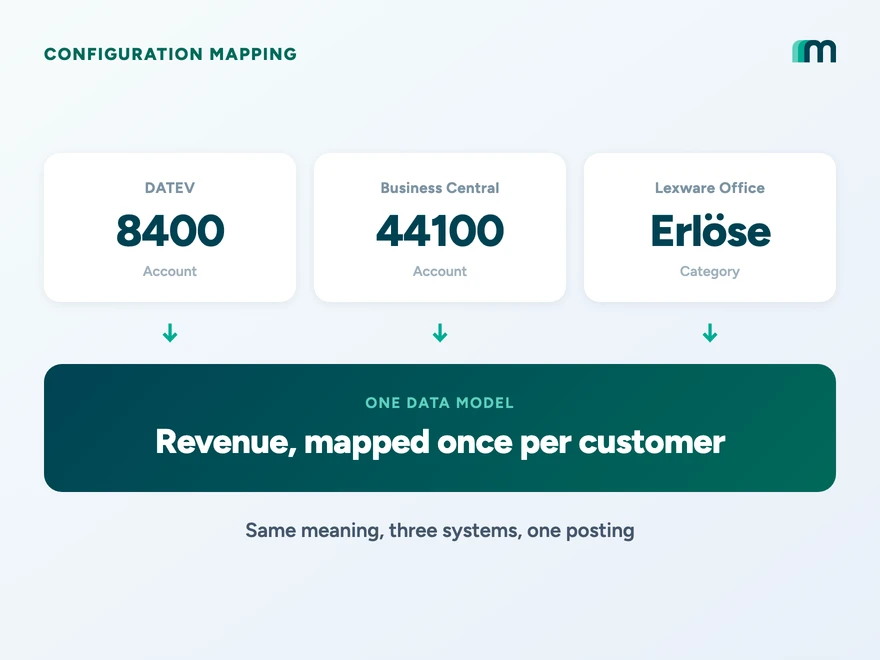
Chart of Accounts Mapping: Cover Every ERP Customisation
Map each object in your platform to the right account, tax code, dimension and company code in your customer's ERP. Standard and custom configuration in one step.
Dr. Themo Voswinckel · 2 Nov 2026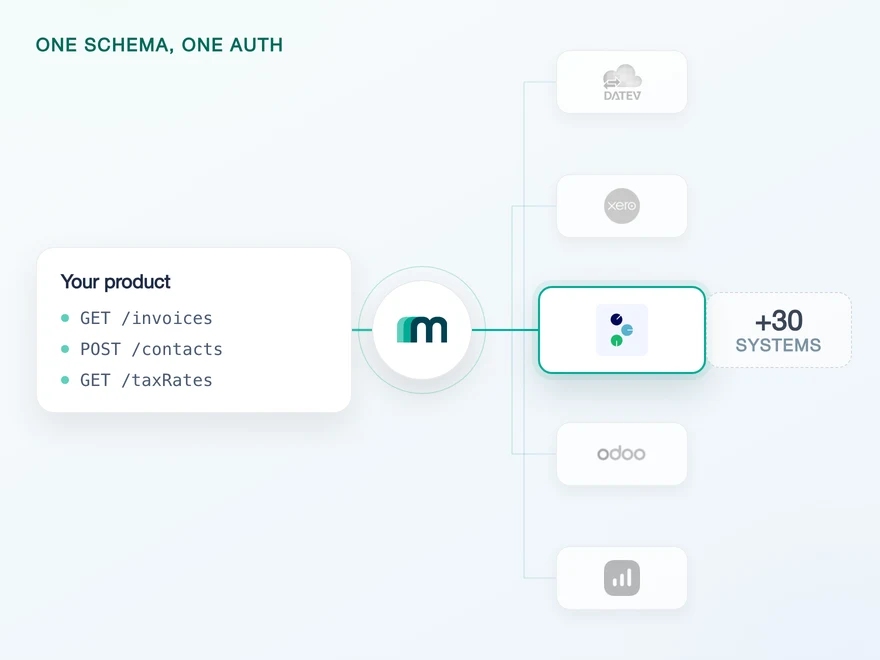
How to Integrate with Tripletex: One Session Token to Send
Tripletex combines two tokens into a third, puts the company in the username field and numbers new journal lines by row. What that means when you build.
 Lennart Svensson · 24 Sept 2026
How to Integrate with Procountor: Run It Unattended
Procountor has two ways in, and the unattended one stops at every endpoint that asks for a second factor. What that means for tokens, syncing and tax mapping.
Lennart Svensson · 28 Aug 2026Build once on the Unified API.
Lexware Office is one system. The integration you build once on our API reaches the other 30+ accounting and ERP systems on the same data model.