Key Takeaways
- The DATEV Datenservice Export Rechnungswesen makes finalised accounting data exportable from the DATEV data centre — postings, accounts, balances and more — for structured use in other software.
- It is read-only. The service exports data out of DATEV Rechnungswesen.
- Only finalised data is available. Entries become exportable after they have been posted and finalised (Festschreibung) and transferred through DATEV's standard posting process.
- The client must enable the service. Activation runs through MyDATEV, and the receiving system needs an approved, functional API.
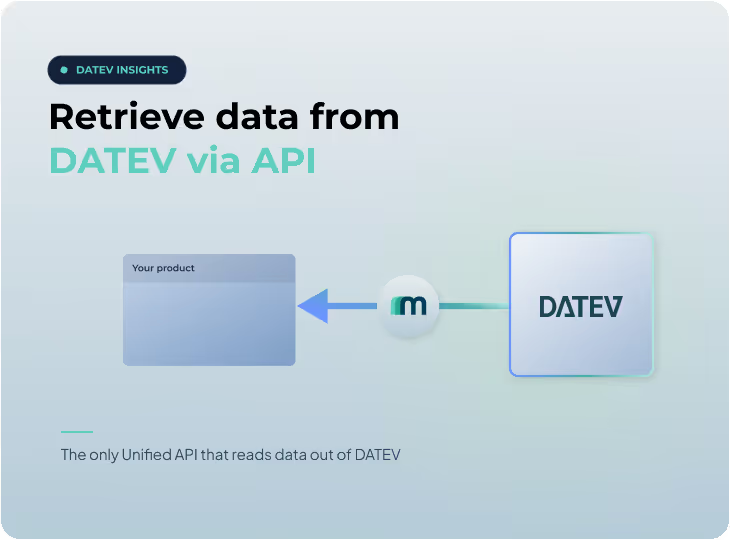
- Maesn is the only Unified API that supports the DATEV Datenservice Export Rechnungswesen — turning DATEV's batch-based XML/CSV processing into one normalised JSON API, with certified-partner onboarding in days instead of months.
What Is the DATEV Datenservice Export Rechnungswesen?
The DATEV Datenservice Export Rechnungswesen is a DATEV cloud service that securely provides financial accounting data from the DATEV data centre for structured, automated processing in third-party software. Where most DATEV interfaces are about getting documents and data into the ecosystem, this service is built for the opposite: making the accounting record that already lives in DATEV Rechnungswesen available to external systems — analytics tools, lending platforms, ERP layers, and AI applications — without manual exports.
The service is delivered through the DATEV data centre (Rechenzentrum), and it is continuously being extended, so the set of available data categories grows over time.
What Data Can You Export from DATEV Rechnungswesen?
The DATEV Datenservice Export Rechnungswesen exposes the core of the financial accounting record. Today it provides:
- Account postings — the individual journal entries that make up the books.
- General ledger (G/L) account numbers — the chart of accounts behind those postings.
- Customer and vendor account numbers — the debtor and creditor accounts.
- Trial balance information — account-level debit and credit totals and balances.
- Payment terms and conditions — the terms attached to the accounting record.
- Fiscal year details — the defined fiscal years and their start and end dates.
Through Maesn, each of these is available in our normalised JSON model, so the data arrives in a consistent shape regardless of the DATEV-specific formatting underneath.
How the DATEV Datenservice Export Rechnungswesen Differs from Other DATEV Services
The DATEV Datenservice Export Rechnungswesen is the export (read) service for finalised accounting data — which sets it apart from the DATEV services built for sending data in. It is easy to confuse the names, so it helps to separate them clearly:
- DATEV Datenservice Export Rechnungswesen (accounting:dataexchange) — reads finalised accounting data out of the DATEV data centre. (The subject of this article.)
- Rechnungsdatenservice 1.0 (accounting:dxso-jobs) — sends structured invoice data and booking proposals into the DATEV ecosystem. See creating booking proposals
- DATEV Buchungsdatenservice (accounting:extf-files)— sends complete posting records (Buchungssätze) into DATEV Rechnungswesen, optionally together with the associated document images.
- DATEV Belegbilderservice (accounting:documents) — transmits document images (PDFs) into DATEV, without the structured booking data behind them.
- DATEV Unternehmen Online — a cloud platform for exchanging documents and structured data between a business and its tax firm; primarily an inbound, collaboration-focused service. See Unternehmen Online vs. Rechnungswesen.
In short: if you need to read the posted books out of DATEV Rechnungswesen, the DATEV Datenservice Export Rechnungswesen is the service that does it.
Why Finalised Postings (Festschreibung) Are a Prerequisite
Accounting data is not exposed through the API the moment it is entered in DATEV Rechnungswesen. Before data becomes available for export, the relevant posting batches (Buchungsstapel) must first be finalised — in DATEV terms, festgeschrieben — and transferred through DATEV's standard posting process. Only data that has been processed and released in this way can be retrieved via the API.
This matters for integration design: an export reflects the finalised state of the books, not work-in-progress entries. It is a feature, not a limitation — what you read is the version of record. When you build on Maesn, you can keep that data as fresh as DATEV's processing allows using scheduled syncs and webhooks, without managing the underlying batch jobs yourself.
How the Service Is Activated
The DATEV Datenservice Export Rechnungswesen must be enabled for the client before any data can be exported. In practice, the client (Mandant) authorises the service — typically via MyDATEV — and the receiving system must have an approved, functional API interface in place to consume the data.
Securing and maintaining that approved interface is normally a multi-step process with DATEV — often involving paid consultants and weeks of waiting just for sandbox access. With Maesn, it is already done: as an official DATEV partner, Maesn has completed certification and the production approval process, so you connect through a certified integration rather than building and validating one yourself. For the exact, step-by-step setup, see the DATEV service configuration guide.
Client Authorisation: The Whitelabel Consent Flow
Beyond enabling the service, an end user — typically the tax consultant or an admin — must explicitly grant permission for a third-party application to access the client's DATEV data. Maesn handles this authorisation (Freigabe) through a whitelabelled consent flow embedded in your own product: the user is guided through a secure DATEV login and approves the connection in a branded experience, without leaving your application.
The resulting access token can remain valid for up to two years, so your application keeps reading data continuously without asking the user to re-authenticate each time. The end result is a smooth onboarding journey for your customers and a stable, long-lived connection for you.
Why Reading Data Out of DATEV Rechnungswesen Is Hard
Getting data out of DATEV has historically been difficult because DATEV is a closed, partner-gated ecosystem built around batch processing rather than real-time REST. Three obstacles show up:
- Partner-gated access. There is no freely available REST API for this; supported, automated retrieval requires becoming an official DATEV partner and passing certification.
- Batch, not real-time. The service relies on asynchronous export jobs and polling, not synchronous calls — so you have to schedule and track jobs to keep data current.
- DATEV-specific formats. Data arrives in XML/CSV with DATEV-specific structures and authentication flows, which every consuming team otherwise has to learn and maintain.
This is why teams that need to retrieve data from DATEV have long fallen back on brittle workarounds: manual DATEV-Format CSV exports out of Kanzlei-Rechnungswesen, run monthly and dependent on an accountant each time; custom builds against DATEV's own data services (DATEVconnect), which carry the full certification and authentication burden; or robotic process automation that scripts the DATEV user interface to scrape Buchungssätze. None of these scale, none are real-time, and all of them add risk.
How Maesn Makes DATEV Rechnungswesen Export Simple
Maesn turns the DATEV Datenservice Export Rechnungswesen into a single, normalised JSON API — and is the only Unified API that supports it. That means one authenticated connection lets you read accounting data out of DATEV the same way you read it from any other system Maesn covers, without touching XML, CSV, batch scheduling, or DATEV-specific authentication.
A request to retrieve postings looks like any other Maesn Unified API call (the full walkthrough, with exact endpoints and parameters, is in the DATEV: retrieve data guide):
GET https://api.maesn.com/accounting/journal-entries
Authorization: Bearer <YOUR_API_KEY>
x-connection-id: <datev-rechnungswesen-connection>
And the response comes back normalised, so it is comparable across clients and systems:
{
  "journalEntries": [
    {
      "id": "je_8842",
      "date": "2026-03-31",
      "lines": [
        { "account": "8400", "type": "credit", "amount": 1000.00 },
        { "account": "1400", "type": "debit",  "amount": 1190.00 }
      ],
      "tax": { "rate": 19, "amount": 190.00 },
      "fiscalYear": "2026"
    }
  ]
}
On top of that, the practical advantages of building through Maesn are:
- One JSON model. Postings, G/L accounts, debtor and creditor accounts, balances, payment terms and fiscal years arrive normalised — no XML or CSV parsing.
- Certified partner onboarding. Maesn's certified DATEV integration means access in as little as a day, instead of weeks of consultants and validation.
- A ready-to-use test environment for both DATEV Rechnungswesen and DATEV Unternehmen Online, so you can start building immediately.
- Fresh data without managing batch jobs. Maesn abstracts the asynchronous export-and-poll flow and supports scheduled syncs and webhooks.
- Build once, connect to many. The same Unified API that reads DATEV also reads 30+ other ERP and accounting systems — one framework instead of a separate integration per system.
- Enterprise-ready by default. Maesn handles concurrency limits, secure transfer and ongoing maintenance, so the connection stays stable without in-house upkeep.
What You Can Build with Exported DATEV Data
Once finalised DATEV accounting data is available through one normalised API, a range of products and internal workflows become straightforward to build:
- Financial analysis and forecasting on live, finalised books — see financial analysis & forecasting.
- Automated underwriting and monitoring for lending and risk, using real accounting data — see automated underwriting with accounting data.
- Multi-entity consolidation across subsidiaries and clients — see multi-entity data consolidation.
- AI assistants that can read your DATEV books in plain language through the Maesn MCP Server.
Security: ISO 27001, GDPR, and Hosting in Germany
Reading financial data out of DATEV does not require giving up control of it. Maesn operates a no-storage architecture, so your accounting data is not persisted in Maesn's systems — there is no second copy sitting in a data lake. Maesn is ISO 27001 certified, GDPR compliant, and built and hosted in Germany, and these guarantees apply to every DATEV request, including exports through the DATEV Datenservice Export Rechnungswesen.
Read DATEV Rechnungswesen Data Through Maesn API
Skip the partner certification, the batch jobs, and the XML/CSV parsing. Read finalised DATEV accounting data through one normalised, secure API. Book a demo and we will set you up with a certified DATEV integration and a test environment.
About the author
Themo is CEO and Co-Founder of Maesn. With years in strategy consulting — spanning requirements engineering for complex software landscapes, ERP and accounting software selections, and end-to-end integration projects — he holds a Dr.-Ing. with a focus on ERP-to-SaaS transformation. He co-founded Maesn to make system integration effortless.

Co-Founder