
Deliver Reconciled Bookings Into Every Accounting System
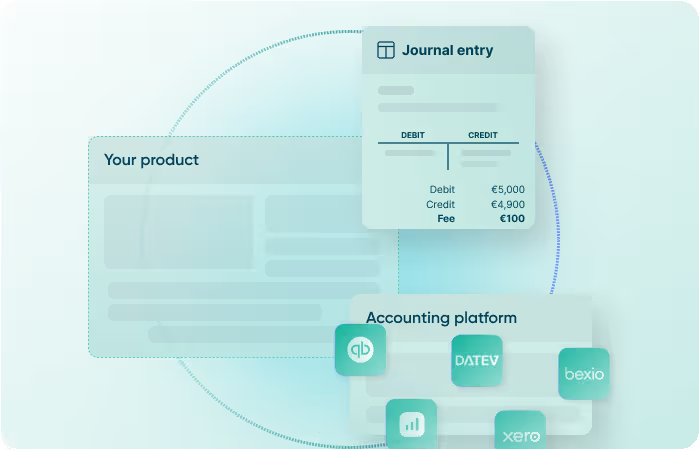
Your product already turns raw payment data into clean journal entries: Accounts mapped, cost centers assigned, tax rates applied, fees split out. Maesn picks up where your reconciliation engine ends and pushes those bookings into DATEV, Sage, Exact, Lexware, Visma and 30+ more - through one API, with full compliance.
















.avif)

















Tipalti's gamechanger: European ERP connectivity for scalable automation
Tipalti, one of the world’s leading AP automation platforms, uses Maesn for multiple ERP integrations, including Exact Online, to accelerate customer expansion across key European markets.
“With Maesn, we accelerated our European expansion by making complex ERP integrations seamless across Benelux and DACH. As an AP platform, reliable access to key local ERP systems is critical and Maesn gives us exactly that.”

Saad Abouyahya
Sr. Manager - Global Technology Platforms & Strategic Partnerships @ Tipalti
You've already solved reconciliation. We solve what comes next.
Building a reconciliation engine is engineering-intensive but bounded. Settlement-lag handling, bundled-payout splitting, IC++ fee decomposition, multi-currency FX, refund and chargeback flows, rolling reserves, multi-PSP normalization - your product already covers the complexity.
The output is a clean ledger of bookings, ready to be posted. Then your customer asks one of these questions, and the project changes shape:
- "Is it automatically synced into our DATEV?"
- "We're on Twinfield - does that work?"
- "Our Dutch entity uses Exact Online."
- "We just migrated to Microsoft Dynamics."
Suddenly you're not maintaining a reconciliation product anymore: You're maintaining 10, 15, 20 accounting integrations. Different APIs, different chart-of-account structures, different cost-center models, different tax-rate handling, different upload formats (Buchungsstapel vs. journal entry vs. CSV vs. XML), different authentication flows. Each binding engineering capacity to build and maintain as systems evolve. That's the work Maesn takes off your plate.
One API. Every accounting system your customers post into.
Your reconciliation engine outputs a journal entry. Maesn maps it to the target system's data model — debits and credits to the customer's chart of accounts, cost centers to their dimensions, tax codes to the right rates, line-level references back to your transactions for audit linkage — and submits it through the right channel. We handle:
- Chart-of-accounts mapping across country charts, and customer-specific custom charts
- Cost centers and dimensions — including the multi-dimensional models in Business Central, Exact,and BMD Tax rate resolution per system, including reverse-charge, mixed rates, and country-specific specifics
- Posting formats — direct journal entries, Buchungsstapel for DATEV, batched imports, scheduled syncs
- Idempotency and retries — so a Maesn restart never causes a double-posting in your customer's ledger
- Audit linkage — every booking posted into the ERP carries a back-reference to the source transaction in your system, keeping the GoBD audit chain unbroken even when bundled entries are used
You ship one integration against Maesn. Your customers get whichever accounting system they're on. Reconciliation engines often need customer and supplier master data from the target ERP to map bookings correctly — Maesn handles that as well. See Customer & Supplier Data Sync.
Power your in-product mapping UI with real ERP data.
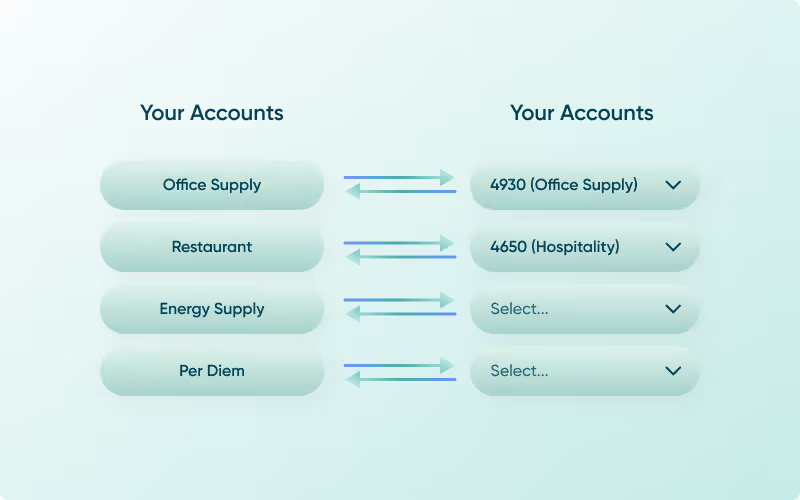
The strongest reconciliation products don't ask their merchant customers to type account numbers and cost-center codes into free-text fields. They build a mapping UI inside their own product, where the merchant connects their ERP once and then maps reconciliation categories to actual accounts, cost centers, and tax codes from their live chart of accounts.
That mapping UI only works if you can read structured master data out of every ERP your customers use. That is the second half of what Maesn does.
Through one API, Maesn exposes:
- Chart of accounts — including hierarchy, account types, and customer-specific account numbering
- Cost centers, cost objects, and dimensions — across single-dimensional (e.g. DATEV) and multi-dimensional (e.g. Business Central, Exact, BMD) models
- Tax rates and tax codes — with country-specific resolution, including reverse-charge and EU-OSS scenarios
- Posting periods, document types, and journals — so your mapping UI can target the right destination
- Currency and exchange-rate setup — for multi-currency reconciliation flows
Your engineering team builds one mapping interface against Maesn's unified data model. Every of your customer, regardless of which ERP they're on, gets a connected, structured mapping experience from day one — instead of a free-text form they get wrong on the first try.
Built for the bookings your engine already produces.
Reconciliation outputs come in many shapes. A POS settlement batch produces hundreds of line items per cycle. A subscription engine produces dunning-aware revenue recognition entries. A spend-management tool produces categorized expense bookings with cost-center splits. A marketplace reconciliation tool produces seller-payout breakdowns with platform-fee allocations.
Maesn's data model handles all of them — single bookings, bundled batches, multi-line entries with split allocations, FX-adjustment lines, period-end accruals, reversal pairs. Whatever your engine emits, Maesn delivers it correctly into the target system.
This includes the realities your customers' tax advisors care about:
- Bundled postings in the ERP with line-level traceability back to your system (the GoBD-compliant pattern)
- Correct period assignment when transactions cross month-end
- Proper handling of pass-through accounts, transit accounts, and clearing logic per chart of accounts
- Correction handling via reversal-and-rebooking rather than mutation, preserving the original entry
One data model. Every country's posting quirks abstracted away.
Pushing a journal entry to DATEV is not the same as pushing one to Exact Online or BMD and the differences run deeper than just API surface.
DATEV expects a Buchungsstapel CSV with Belegfeld 1, Belegfeld 2, and OPOS conventions. BMD wants KZ-fields and sector-specific account codes. French systems require FEC-compatible exports for tax audits. Italian systems demand Codice IVA per line. Polish systems embed JPK and KSeF references. Belgian PCMN coding is its own world.
Your engine should not have to know any of this.
Maesn unifies all these formats behind a single posting model. You send a clean booking — debits, credits, amount, currency, account references, cost centers, tax codes, line-level metadata. Maesn translates it into whatever the target system actually expects, fills in the country-specific fields, applies the right format conventions, and submits it through the right channel.
The result: your engineering team writes one integration against one data model. Country-specific complexity stays where it belongs — in the integration layer, not in your product.
Official partner status with the systems your customers rely on.
Maesn integrations are built and operated as official technology partner with DATEV (Interface Partner / DATEV Marktplatz), Exact Online (Exact App Centre), Lexware, sevdesk, Sage, and Microsoft. That matters when your customer's tax advisor asks where their data is going — and when they want to see your product in their accounting system's marketplace.
You ship reconciliation. Your customers get bookings in any system.
Stop building and maintaining a separate connector for every accounting and ERP system in your customers' stack. Maesn gives you a single integration point that covers them all — so you ship once and stay focused on what your engine actually does, today and as your customers' stack evolves.
Looking for something different?
Payment reconciliation is one of several places where Maesn delivers structured financial data into customer ERPs. If your product sits in a different part of the stack:
- If you're building dunning, cash-application, or invoice-tracking software that needs to read open items and post invoices into customer ERPs, see Accounts Receivable Automation.
- If you're building invoice-payment, AP-automation, or supplier-management tools, see Accounts Payable Automation.
- If you're building expense, spend-management, or travel-and-card products that need to push categorized expense data into customer accounting systems, see Expense Sync.
Still have questions?
Not sure if your use case is covered or want to walk through your setup with us? We're happy to take a look and find the best way to get you integrated fast.
Get a demoWe are European.
Enterprise-grade security & compliance are our foundation.
Built and hosted in Germany to meet the highest security and compliance standards, Maesn processes API calls in real time without storing customer data and is fully ISO 27001 & GDPR compliant.
Frequently
Asked
Questions
You have more questions? We are looking forward hearing from you - book a meeting now!
Does Maesn replace your reconciliation engine?
No. Maesn is a delivery layer that picks up where your reconciliation engine ends. Your product continues to do what it does best — categorizing transactions, splitting fees, mapping accounts, applying tax logic. Maesn takes those finished bookings and pushes them into the customer's accounting system. We don't compete with your core IP; we extend its reach.
What's the difference between Payment Reconciliation, AR Automation, and AP Automation in your platform?
The capabilities use the same underlying infrastructure but solve different problems for different products. Payment Reconciliation is for software that produces reconciled bookings and needs to post them into customer ERPs — typical for POS, marketplace, subscription, and dedicated reconciliation tools. AR Automation is for products that read open receivables and post invoices on the receivables side — typical for dunning and cash-application tools. AP Automation is for products that handle invoice-payment workflows on the payables side. If your output is reconciled journal entries, this page is the right place.
Does Maesn support pushing bookings into DATEV?
Yes. Maesn is an official DATEV Interface Partner and supports direct posting via the DATEV API as well as Buchungsstapel-format generation where required. Account references, cost centers (KOST1 / KOST2), Belegfeld 1 and 2, and Buchungstext fields are mapped from your unified Maesn payload to DATEV's expected structure automatically.
Can our customers map reconciliation categories to their own accounts and cost centers?
Yes and this is one of the most-used capabilities by reconciliation vendors on Maesn. Through our master-data API, your product can read the customer's live chart of accounts, cost centers, tax codes, and dimensions directly out of their connected ERP. You build the mapping UI inside your own product, populated with real data from the customer's accounting system. Merchants map once during onboarding; subsequent bookings flow through automatically.
How long does it typically take to integrate Maesn?
Most reconciliation vendors complete a working integration in two to four weeks from kickoff to first end-to-end posting in a customer ERP. Time-to-production depends mainly on how your reconciliation engine emits its output today. Teams already producing structured journal entries integrate fastest; those who need to refactor an output layer first take a bit longer. Our team supports the technical onboarding directly.
What happens if a posting fails or needs to be corrected?
Every Maesn posting carries an idempotency key, so retries after transient failures (network interruptions, ERP downtime) never produce duplicate entries. For corrections after a posting has succeeded, Maesn supports the GoBD-compliant pattern of reversal-and-rebooking rather than mutation — preserving the original entry and creating a clearly marked reversal plus a corrected new entry. This keeps the audit trail intact.