Twinfield is a cloud accounting platform used by accounting firms and SMEs across the Netherlands, Belgium, and the UK. It is part of the Wolters Kluwer group and is particularly popular with accounting practices managing multiple client entities.
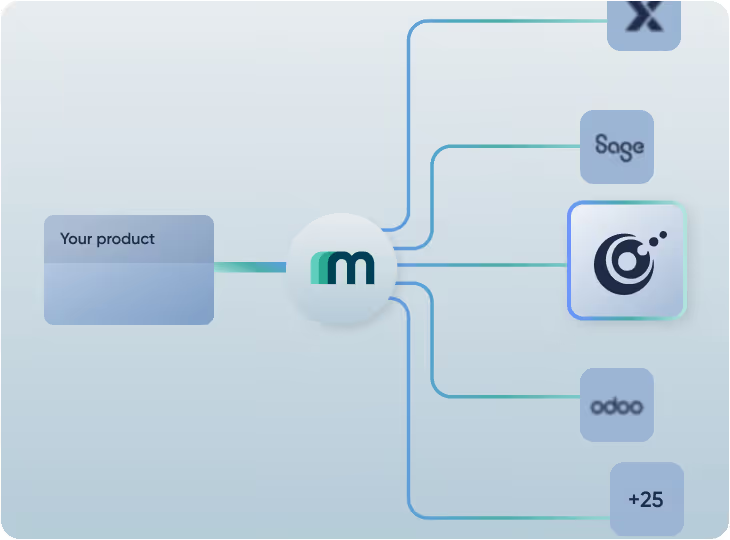
Integrate Twinfield ERP alongside dozens of other accounting and ERP systems through Maesn Unified API.
















.avif)
















Getting a Twinfield sandbox requires buying an instance. Maesn provides a sandbox immediately at no additional cost, so you can start building from day one.
Twinfield's marketplace has 650+ listings and is a key channel for the Dutch and Belgian market. Maesn supports you through the individual qualification process to get your integration listed.
Twinfield uses SOAP/XML, cluster-specific routing, and strict multi-entity structures. Maesn supports you with technical, market-specific and compliance questions at every stage.

Findity is an AI-powered expense management platform. They offer white-label and API solutions, enabling partners to embed fully branded expense technology directly into their own products.
"Maesn has helped us build integrations with accounting systems, allowing us to focus on other priorities in our roadmap. We are especially pleased with the support we have received whenever we needed extended functionality in an integration that Maesn has arranged for us."

Per Q.
CTO @ Findity

Unified. Certified. Production-ready.
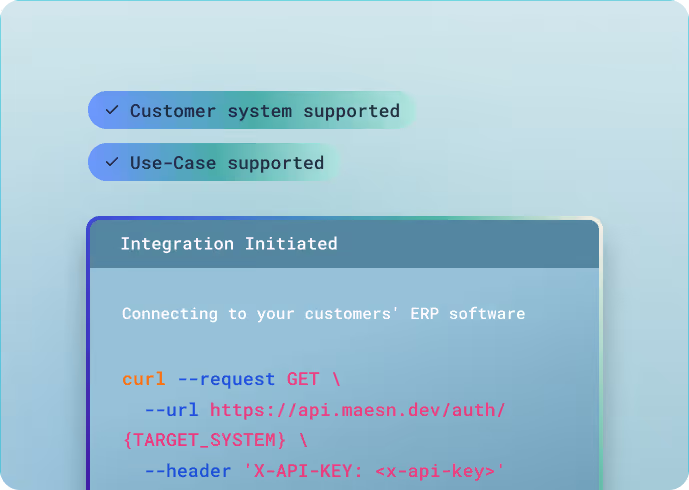
Twinfield's primary API is SOAP-based and requires XML envelopeconstruction on every request. Maesn exposes Twinfield through a standard RESTinterface and handles all XML construction and parsing internally.
Full SOAP to REST abstraction by Maesn
No XML envelope construction required
Same REST interface as every other system
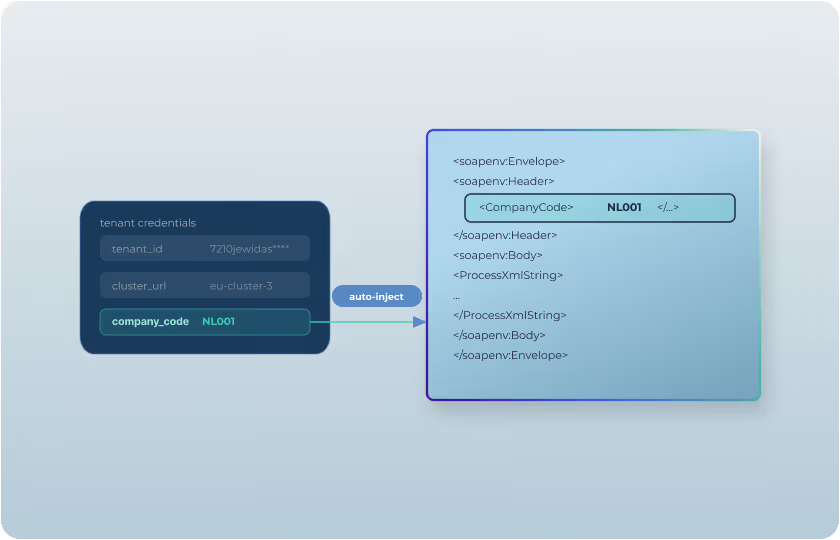
Every Twinfield request requires a CompanyCode in the SOAP header. Maesn stores the CompanyCode per tenant after authentication and injects it into every request automatically.
CompanyCode stored after authentication
Injected into every SOAP request automatically
No Twinfield-specific header logic on your end
.avif)
After authentication, Twinfield returns a cluster-specific base URL required for all subsequent requests. Maesn resolves this during onboarding and routes every request to the correct cluster per tenant, no extra configuration needed.
Cluster URL resolved during onboarding
Correct routing per tenant automatically
No cluster-specific configuration on your end
Twinfield has an active partner marketplace with a strong user base across the Benelux region and beyond. Becoming a listed technology partner gives your product direct visibility within Twinfield's ecosystem. Maesn supports you through the partner onboarding process and provides a sandbox environment for Twinfield, so you can start building and qualifying immediately.
Twinfield sandbox provided by Maesn
Partner onboarding supported by Maesn
Direct visibility in the Twinfield partner ecosystem
.avif)
.avif)
The Maesn docs cover every Twinfield endpoint, authentication flow and implementation detail. Plus a full overview of the current coverage, which is continuously being expanded.
Full Twinfield documentation
Current coverage overview at a glance
Continuously expanding endpoints & integrations

Get your product and brand name listed at Twinfield marketplace
and benefit from a great audience and strong co-marketing activities.

Get insights and learn about the most imoportant systems in our country-by-country view of the European ERP and Accounting software landscape.
.avif)
Maesn exposes Twinfield through a standard REST interface and handles all XML construction internally.
Maesn resolves the cluster-specific URL and stores the CompanyCode per tenant, injecting both into every request automatically.
Once Twinfield is live, every other system Maesn supports is immediately accessible. No additional implementation needed.
We are European.
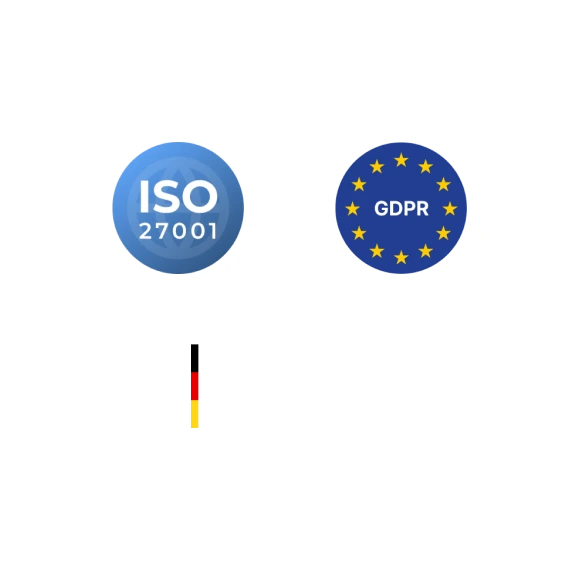
Built and hosted in Germany to meet the highest security and compliance standards, Maesn processes API calls in real time without storing customer data and is fully ISO 27001 & GDPR compliant.
Everything you need to know about Twinfield API Integration.
You have more questions? We are looking forward hearing from you - book a meeting now!
Twinfield is a cloud-based accounting platform by Wolters Kluwer, widely used across the Benelux region and beyond, offering tools for financial administration, bookkeeping, and reporting for SMBs and mid-market companies.
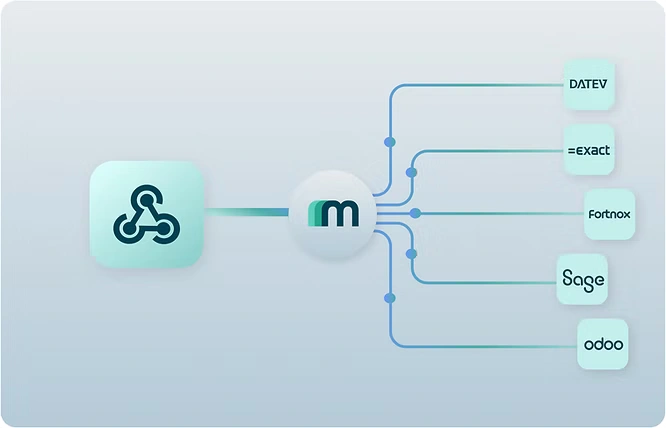
Integrating via Maesn eliminates all Twinfield-specific complexity. SOAP to REST abstraction, XML construction, cluster URL routing and CompanyCode injection are all handled automatically behind one unified API. Plus, you immediately gain access to dozens of other accounting and ERP systems.
Twinfield's primary API is SOAP-based and requires XML envelope construction on every request. Maesn exposes Twinfield through a standard REST interface and handles all XML construction and parsing internally, so you never have to deal with SOAP directly.
After authentication, Twinfield returns a cluster-specific base URL that must be used for all subsequent requests. Maesn resolves this during onboarding and routes every request to the correct cluster per tenant automatically.
Every Twinfield request requires a CompanyCode in the SOAP header. Maesn stores the CompanyCode per tenant after authentication and injects it into every request automatically. No custom header logic required on your end.
Twinfield does not offer webhooks natively. Maesn fills this gap with synthetic webhooks, covering every object and every event in a normalized payload, consistent with every other system in your stack.
Yes. Maesn provides a Twinfield sandbox environment directly, as Twinfield does not offer one independently. This means you can start building and testing your integration immediately.
Yes. Maesn supports you through the Twinfield partner onboarding process, giving your product direct visibility within Twinfield's partner ecosystem across the Benelux region and beyond.
Maesn supports invoices, bills, credit notes, customers, suppliers, payments, journal entries, and more. Coverage is continuously expanding and endpoints can be added on demand.
Maesn uses HTTPS and TLS for all data transfer and does not store any customer data. The platform is hosted on Microsoft Azure in Frankfurt, Germany, and is fully GDPR compliant.

.webp)
.webp)