.webp)
Key Takeaways
- Snelstart is a key accounting system in the Dutch SME market, making integration highly relevant for SaaS vendors operating in the Netherlands.
- API documentation access is restricted and available only in Dutch
- Authentication is multi-layered and requires active token lifecycle management due to hourly token expiration.
- Business objects are fragmented, often requiring multiple dependent API calls and custom orchestration logic.
- Tax handling in booking proposals requires duplicate representations at booking and line-item level, increasing payload complexity.
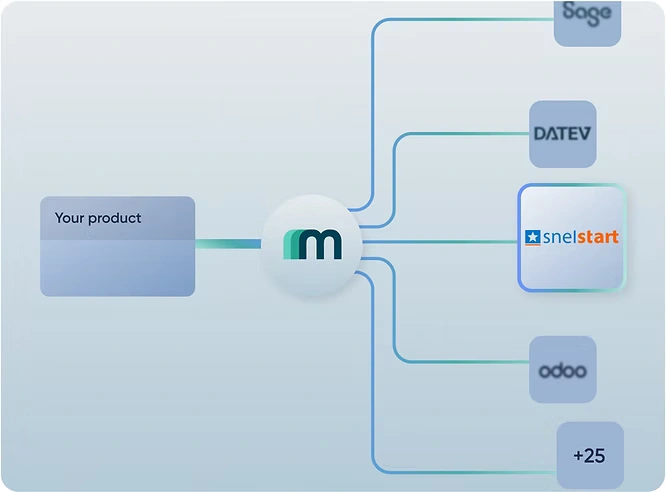
- Using Maesn Unified API abstracts authentication, normalize data models, and resolve multi-call dependencies to simplify scalable integrations.
API documentation access is restricted and Dutch-only
Access to the Snelstart API documentation requires prior registration. Developers must request access before viewing the full API specification, and publicly available technical details are limited. In addition, the official documentation is available exclusively in Dutch. For international engineering teams, this adds a translation and interpretation layer during onboarding and implementation. For software teams integrating multiple accounting integrations, this can slow down technical discovery and validation.
With Maesn, the documentation is fully accessible in English and structured consistently across systems. This allows teams to evaluate and implement integrations without registration barriers or language constraints.
Authentication is multi-layered and requires active token lifecycle management
The Snelstart API does not rely on a standard authorization flow. Instead, it uses a layered authentication setup combined with short-lived access tokens.
The authentication flow includes:
- A subscription key, which must be sent as a header with every request.
- A user-generated API key, created manually within Snelstart.
- An access token, obtained by exchanging the API key and valid for one hour.
Every API call requires both the subscription key and the temporary access token. As a result, integrators must implement automated token exchange logic, handle hourly refreshes, manage expiration errors, and ensure secure credential storage. In multi-tenant SaaS architectures, this adds operational complexity that needs to be carefully managed to ensure reliability at scale.
When integrating via Maesn, authentication and token lifecycle management are fully handled in the background. Integrators only need to manage the Account Key received during the Maesn authentication flow, while all token exchanges and refresh processes are maintained automatically.
Business objects are fragmented and require orchestration logic
Snelstart frequently exposes business objects in a fragmented manner. A single API response often does not contain all information required for common integration use cases.
For example, contact records may reference a country ID rather than a standardized country code. To retrieve the corresponding country details, an additional API call to a separate endpoint is required. The integrator must then resolve and map this information into a usable format, such as an ISO country code.
Because Snelstart allows countries to be created, modified, or deleted, reference data cannot always be treated as static. This requires dependency-aware synchronization logic and, in many cases, caching strategies to avoid excessive API calls. Without careful orchestration, performance and consistency issues may arise.
Through Maesn, all Snelstart objects are aligned to a unified Common Data Model. Multi-call dependencies and reference resolution are handled within Maesn, so integrators work with fully normalized objects without implementing system-specific orchestration logic.
Ready to Start?
Check our Snelstart in the Docs!
Tax handling and booking proposals follow an internally structured data model
The structure of booking proposals in Snelstart reflects internal accounting logic rather than an integration-first API design. When creating booking proposals, tax information must be included at both: the main booking level and at each individual line-item level. These representations are mandatory and must be consistent with one another. Any mismatch can result in validation errors.
This often requires transformation logic to align internal data structures with Snelstart’s expected payload format. The duplication of tax data increases the need for robust validation and error handling mechanisms during integration.
When using Maesn, tax structures are mapped to our unified data model. The required duplication and format transformations for Snelstart are handled by Maesn, allowing integrators to work with a single consistent booking and tax structure across systems.
Scalable Snelstart integrations benefit from Maesn Unified API
Direct integration with Snelstart is feasible, but it requires careful architectural planning due to documentation constraints, authentication complexity, fragmented object retrieval, and internally structured tax logic.
For this reason, software teams choose to integrate Snelstart through Maesn Unified API. That centralize authentication handling, normalize object structures into a consistent data model and resolve multi-call dependencies. This approach allows Snelstart to be treated the same way as all other accounting systems supported by Maesn.
About the author
Themo is CEO and Co-Founder of Maesn. With years in strategy consulting — spanning requirements engineering for complex software landscapes, ERP and accounting software selections, and end-to-end integration projects — he holds a Dr.-Ing. with a focus on ERP-to-SaaS transformation. He co-founded Maesn to make system integration effortless.

Co-Founder
.webp)